Memories of Menesa
Chapter 1: An Abandoned Creature
1-1 First Breath in 1000 Years
After an age of silence, there came a hissing sound. This sound was misinterpreted by a sleeping brain as the presence of a lord. Conditioned to heed such a sound, the creature gradually regained consciousness. It felt a chill, as cold air seeped into its tiny chamber.
Opening its eyes, it saw vague lights and shadows obscured through frosted glass. A dark figure approached. The figure touched the glass, wiping away frost and fog with a hand. There was something off about the shape of the hand. It seemed to have an extra finger. The figure backed away. A man's voice spoke quietly. A higher-pitched voice replied; a woman? Or was it a young boy? The words were unintelligible.
As the glass moved upward and out of sight, there came an overwhelming feeling of coldness, as frigid air entered lungs which had lied empty for so long. Exposed skin formed goosebumps.
The man said something again. There was a questioning tone to it, but the language was unfamiliar. The creature answered slowly and unevenly, its vocal cords vibrating for the first time in a thousand years. The man just stared.
There were two others with him. One was a girl who looked on the cusp of adulthood. The other, hanging further back in caution, was a teen boy.
All three of them had similar features: black hair, brown eyes, dusky skin the color of dark wood. They all had the same sort of hands: four curiously short fingers and a thumb. They wore simple, draping clothes accented with bright colors. Though their fingers and their pigmentation were strange, they otherwise looked like ordinary servants.
The creature slowly stepped out of its sleeping capsule. This simple movement was laborious. It saw a box at its feet. It stooped to open it without thinking, driven by subconscious memory. It reached in, thinking to clothe itself. But where it imagined clothes, there were only a few moth-eaten threads of brittle cloth.
Something not exactly cloth remained. It was neatly folded into a square, but it had a rubbery, scaly texture. The dried out skin of some great reptile. The creature picked it up and held it to its chest. It didn't know why, but the thing brought up a vaguely affectionate, almost reverent feeling. It put the folded skin back into the box.
There was another object in the box. Its cloth handle was crumbling, but the tool itself was one solid piece of metal, perfectly intact. It was a knife-like thing, though it ended in a round hook. The outer edge was blunt, while the tip and inner part of the hook were razor sharp. The creature didn't know what it was for, but it felt familiar and comforting. The three observers tensed up when the creature raised the thing, but when it made no sudden movements, they relaxed a little.
1-2 First Contact
The creature shivered as it beheld the onlookers. Its mind was a haze. The man untied a rolled blanket from his pack, unfurled it, and cautiously held it out.
Unable to resist the warmth on offer, the creature pounced. Dropping the hook-knife and ignoring the blanket, it clawed at the man, reaching under his loose shirt so that its fingers touched his belly. The man gasped and toppled to the ground. The creature fell on top of him, fingers held firm in animal need.
The girl recoiled, stumbling backward. But the boy, wielding a hefty tree limb which had been fashioned into a simple staff, laid heavy blows upon the creature's back. It moaned. The kick of a boot then shoved it away. Now slumped alone on the floor, the creature cowered, shielding its face with its hands. It felt another smack against its arms. But then the blows stopped.
The man, still on the ground, had staid the younger's hand with words alone. The man now looked pale and sick, and he was already shivering from the heat transference. But after the man spoke, the boy reluctantly lowered the staff and stepped back.
The creature reached out for the blanket, which was now lying on the ground. It rolled the blanket neatly, and, though still cowering, held it out with one hand. A peace offering. Still shivering, the man cautiously took it, unfolded it, then draped in over the creature's shoulders. Unfurling his pack, he retrieved another blanket for himself.
The strangers exchanged more words among themselves quietly. They inspected the man for wounds, and saw the marks on his belly were only scratches and pinpricks from where the creature's fingers had clung. Then, they seemed to debate something. The boy was animated; the man was calm and firm. The girl made some kind of suggestion, to which the man considered seriously for a moment, then nodded.
1-3 Slate Conversation
The girl stepped forward, holding a slate tablet. The boy stood to the side, quarterstaff in hand, seemingly ready to strike, but he waited. The girl's face was a mixture of caution and determination. With a piece of chalk, she drew two glyphs, a subject and a verb. Then, she added a diamond-shaped glyph before the other two, indicating a question.

The creature spoke. The girl shook her head. The creature stepped forward, and the girl instinctively took a small step back, like a scared animal. The creature persisted, took the tablet from the girls hands, wiped away the chalk and drew a triangle. For its kind, this was the first and most essential word.

The girl seemed pleased by the sight of this glyph. She wrote more.

"Mitra," said the girl, holding up the tablet and pointing to herself with the other hand. Then she pointed at the creature.

When the creature did not respond right away, the girl erased the glyph and tried again with greater care.

The creature took the tablet, then hesitated. It was a simple question, but... the creature's mind, much like its body, seemed to still be warming up. It gently slumped onto the floor. After a long pause, it wrote three glyphs.

Here, Mitra encountered her first challenge, and this made her anxious. Her ability to translate might determine the outcome of this whole encounter. She felt the creature's golden, vaguely predatory eyes on her. Her father and brother also watched.
The swirly thingy meant knowledge or understanding, which she had herself just used as a verb earlier in the same way. So she initially read it as "I know past." She wasn't clear if this was the creature's name, or if it was an unrelated message. If there was a way the ancients denoted proper nouns, she wasn't aware of it.
Then, she realized the swirl was vertically flipped here. She recalled her studies. An inverted glyph conveyed a related but opposite or otherwise inverted meaning, often denoting that the right-side-up noun was missing or hollow. You could flip "communication" to get "deception," for example. So flipped knowledge was... ignorance or misconception, maybe? Something like that. And it was related to the past...
Self (subject), Ignorance (verb), Past (object). Reasoning it out, Mitra spoke aloud to herself quietly. "So you don't remember." The creature, of course, didn't understand the spoken words. For another moment, the girl talked with the man privately. Carefully and with some visible uncertainty, she wrote a longer construction.

It was the creature's turn for confusion. The first three glyphs were a straightforward sentence, "we are friends." But the last three formed a complex modifier, likely to denote what exactly they were friends of. The water and body glyphs together meant blood. The last glyph was an inverted heat glyph. An odd choice, but perhaps the girl didn't know the glyph for "cold."
That didn't clarify much, however. The creature wrote a reply.

Mitra pointed to the creature. "You."
The creature considered this. Its ability to consider things was rapidly increasing as time went on. This was good. Judging by the abundance of warmth it was able to absorb from the man, these strange people were warm-blooded mammals, like wolves or monkeys. "Coldblood," then, was a sensible label from their perspective.
Mitra talked again to the man. The boy chimed in this time, too. Mitra wrote more glyphs.

The creature -- the coldblood -- stood up. Mitra wrote more. This time, she wrote at length and with confidence.
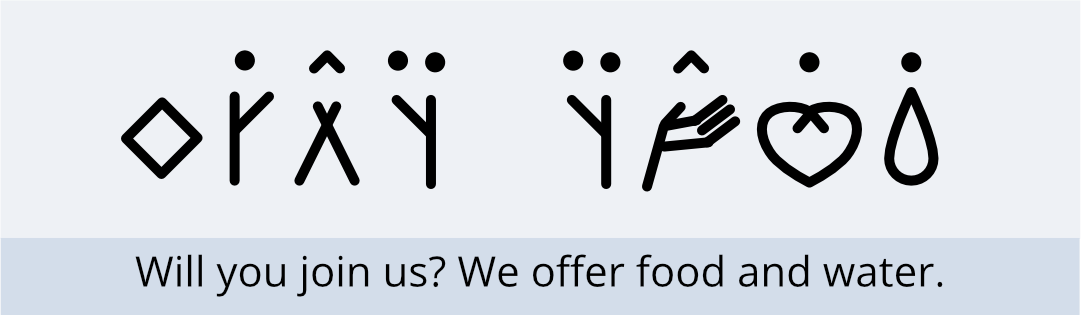
The coldblood understood the question, but ignored it. Instead, it wrote:

The coldblood watched the girl for an answer. The girl only frowned. A hint of sadness seem to come over her. Then she led the coldblood to a nearby chamber in the cave, and pointed. There were two more sleeping pods. But no light came from them. The coldblood approached and looked closely. It wiped away frost from the glass, revealing the shriveled flesh of a long dead creature. The other chamber was the same.
Mitra wrote on the tablet. Here motions were less eager, more solemn. Twice, she began a message and erased it, before settling on something simpler.

After holding up this simple message for a minute, the girl continued.


Mitra hesitated again, writing more.

But the coldblood didn't answer. It refused the tablet. It turned away.
1-4 Leaving the Cave
When the coldblood's eyes adjusted to the overwhelming whiteness, shapes became clear. The cave opened onto a mountainside with a brilliantly lit vista of the mountains beyond. The jagged outline of these mountains on the horizon was familiar. But the colors were wrong. Everything was white. The coldblood felt a vague memory that these sights were supposed to be green and brown, with lush vegetation growing through sandy soil.
Quite close by, on the sloped mountainside, a group of people were gathered. They were the same sort as the other three, with similar clothing and features, about fifty in all. Among them were two dozen beasts. They were a kind of bird, stocky and flightless, with long flexible necks and strong, bony legs. They were the size of horses and were loaded with an assortment of travel packs.
One by one, the people took notice of the coldblood. They talked among themselves. Some were trying not to stare, while other stared openly.
Mitra quietly appeared beside the coldblood, writing on the tablet.
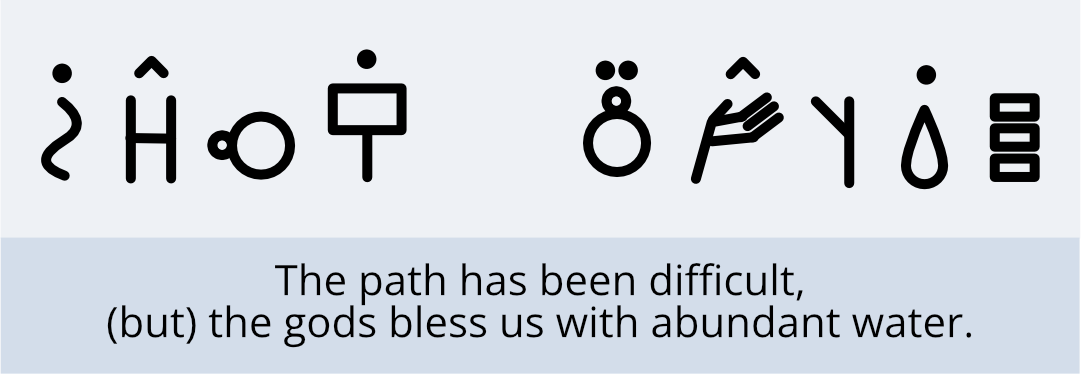
Leading the coldblood into the midst of the others, she gestured to a pot of water which had evidently been recently taken off the fire.
the coldblood walked toward it instinctively, not out of thirst -- for its desire for food and drink was still dormant -- but because the puff of steam was a sign of warmth. The coldblood cautiously touched the metal and found it was just cool enough to touch. It held its face over the bucket and felt the steam.
In the bucket, the coldblood saw its reflection. It saw a woman not entirely dissimilar from these travelers it now stood among. But not entirely like them, either. Her skin was a colorless light gray with a smooth texture, like wet clay. Subconsciously, she found this grayness reassuring. A sign of health.
Her nose was only a small bump, with nostrils almost flat against her face. Her eyes were golden, with a faintly metallic sheen, like a cat's eye. Pale blonde hair framed the face. She smoothed the hair down with water as she examined her face carefully. It was not the face of a stranger. Between the sight of it and the warmth of the bucket, a sense of self came into view. She felt an ongoing shift in her mentality, a shift which had begun from her first awakening but was now becoming clearer. A shift from the instinctual to the intellectual. She still could not call to mind any clear memories, but she did not feel entirely lost. She felt calm, after the disposition of her kind.
She looked at her hands, which she had not consciously done until now. They featured three long, bony fingers and a thumb, tipped with sharp, claw-like fingernails. These, too, were familiar, unlike the oddly small, five-fingered hands of the brown-skinned travelers. She glanced at the group of them on the hillside. Many were still watching her, others were at least pretending to get on with their various tasks. Humans, Mitra had said they were called. They seemed to be a primitive race, but at least they were communal, civil. The structure of their hierarchy was not immediately clear.
She drank the water, savoring its warmth.
Mitra was nowhere to be seen, but a few moments later she appeared again, together with the man and the boy. The coldblood got the impression they had just discussed something at length. Mitra presented the tablet.

"Menesa," said Mitra aloud, pointing at the coldblood. "Menesa."
Mitra wrote more.
Chapter 2: The Pilgrims
2-1 Pilgrims Explained
And so it was that the presence of the coldblood called Menesa was cautiously accepted by a nomadic tribe of Yobani humans.
Mitra's chief duty, it seemed, was now speaking with with Menesa via the chalk tablet. This went smoothly, with both Mitra and Menesa sometimes speaking aloud in their native tongues, but relying on the tablet to convey understanding. To Menesa, Mitra's sentences on the tablet were unsophisticated and prone to odd word choices, as if written by a child. But the meaning was usually clear, and she was beginning to write more quickly and confidently. Menesa began to ask questions about Mitra's people.
Apparently, humans were the most numerous race of the age and could be found almost everywhere, but they were not a unified civilization. Mitra's people called themselves the Yobani. They were nomads from a desert far to the south, and were unfamiliar with these northern mountains. They were here on a pilgrimage to find a new homeland. Why? A prophecy spoke of the founding of a new tribe in a place where the ancients once dwelled. The necessity of doing so was unclear even to the Yobani, but many hoped for a land where food and water were more abundant.
A few of them, Mitra admitted, had begun to waver in their resolve, as the way had been hard. But she was confident they would come around. Mitra for her part, was unwavering. She insisted that they should not put their faith in any particular outcome. They would simply follow their road to the end.
Which road? Following the prophecy, they were to find a plateau where the last star fell between twin fangs, beneath the arc of heaven. The elders had some idea where this might be, and it was on this basis that their journey began.
The Arc of Heaven was a term Menesa recognized. It was a bow of light that could be clearly seen on the horizon at night, always due south. The reference to fangs and a last star were unfamiliar, however.
The Fangs were something still far away, Mitra said. They didn't exist when the prophecy was written, which only added to its legitimacy. If you travel with us, we can see them together someday.
2-2 About the Birds
Morning came, and Menesa watched the tribe feed and groom the birds. The birds, Menesa learned, were called badahn. Though they were the size of horses, they seemed to serve primarily as pack animals rather than mounts. The people walked beside them, trudging through the snow while the birds carried an assortment of packs. Of the thirty humans, all of them walked except two, who rode on the backs of birds: an impossibly old man and a pregnant woman.
On the way, one of these beasts began crying out, flapping, dropping feathers, causing bits and bobs tied to luggage to come tumbling off. It had slipped on an icy stone on its climb and ended up with a leg injury. Mud mixed with blood on the leg.
Menesa happened to be near the bird when this occurred. Menesa found an unattended rag and the bucket of hot water. She cautiously approached the bird. Seeing her intention, a man nearby got the bird's attention, and began stroking its neck feathers. He fed it a morsel of dry bread. It seemed to soothe the beast.
Menesa cleaned the wound, first picking out splinters of rock, pinching the sharp tips of her fingernails together like tweezers. Then she cleaned the mud out of the scaly skin, careful not to tug at the wound more than necessary. Finally, she wiped the blood off her fingertips with the rag, then rinsed it out. She did all of this quickly and gently, almost without thinking.
An older woman approached, speaking in the Yobani language. She held an herbal poultice ground into a greenish paste in a mortar. She pointed to the bird's now clean, but still bloody wound, where a tear in its scaly skin could be seen. She made a spreading motion with both hands, and handed Menesa the poultice. Menesa took it and spread the paste on the wound. The older woman looked on approvingly, then tied a cloth over the wound, and walked away.
The bird now seemed comparatively content, though it walked with a minor limp. Menesa continued looking at the bird's scaly leg, transfixed. Something about the past few moments began to make images of her former life bubble to the surface. What's more, she noted that this task had been oddly satisfying, almost pleasurable, like scratching an itch. She wanted to do it again, but there was nothing more to do here.
Menesa found a quiet corner alone. She observed the relationship between the humans and the badahn. The humans were beings of the desert, journeying through the snow. The badahn seemed predisposed to serve the humans. Was this a result of conditioning, or did humans create them for this purpose, just as the lords created her own kind? Or perhaps it was a consequence of their nature. Birds blessed with great stature but cursed to wander about on foot with the beasts. Such a creature, it seemed to her, might be destined to find its place in the service of its more intelligent neighbors.
2-3 A Starless Sky
That night, they made camp in a flat clearing shielded by pines. As the light dwindled, people lit lamps. The lamps looked to be made of gourds filled with a clear oil -- simple, but effective. To Menesa, these dots of light spread across the darkening camp looked like stars in a night sky.
Seconds after this thought, Menesa experienced a quiet shock. A creeping realization that there was something wrong with the sky. The arc of heaven was still there: the great golden bow above the southern horizon. That at least was a sort of mental anchor, an assurance there was still something recognizable in the world she had awoken into. But the rest of the sky was far too dark. Where there should have been a midnight blue dotted with countless stars, the sky was almost pure black, without a single star. It seemed too dark and too complete to be cloud cover. And yet, on close inspection, the blackness was not exactly uniform either. Once in a while, it subtly rippled, as if the night sky were made of black silk wavering in a breeze.
At length, she did spot a single, lonely star in the East. She stared at it, searching in vain for meaning. Was this the so-called "last star" in the humans' prophecy? Something about the term "last star" gave Menesa a chill. It implied the stars had been lost. What exactly had happened between her age and this one?
Deep in thought, Menesa didn't notice the approach of the boy. The boy was Mitra's younger brother, and was named Pouya. When she noticed him, he was sitting just a few feet away, staring at her. This startled her, as the memory of his staff upon her back was fresh in her mind.
He turned away at the eye contact, but then he came closer. He pointed at the sky and began talking. There was a questioning tone. And while Menesa was already starting to intuit the basic structure of the humans' spoken language, and she caught that he used the word meaning "you", she didn't have much clue what he was saying.
Mitra and her brother got into a discussion. Mitra folded her arms as Pouya pointed at the sky again. Mitra began writing glyphs on the tablet again. Pouya nodded with approval at the first sentence. Apparently he was a student of the language as well, though not yet confident enough to try writing it. Then, after inspecting the final phrase carefully, he tried to grab the tablet from Mitra's hands. She nimbly dodged, laughing. He loomed over her while she held the tablet behind her back, looking up at him triumphantly. Pouya was notably bigger than Mitra, but she seemed to know he wouldn't dare use this advantage. In the end, Pouya just glanced at Menesa again, then walked away.
After another brief exchange between them as he left, Mitra approached Menesa revealed the tablet.
Mitra: He wants to know if you truly saw the stars. We are taught your age had a thousand thousand stars, but not everyone believes this.
Menesa nodded and circled the repeated character "thousand thousand".
Mitra: Also, he wants to know if you are okay. He feels badly about hitting you.
Mitra glanced at the black-and-blue bruises on Menesa's arms, where she had protected her face from Pouya's staff.
Menesa: I am good. Your father?
Mitra: Improving.
Menesa sighed.
Mitra: Also, Pouya thinks you're pretty.
Menesa looked out at the boy, who was already a ways away, concerning himself with some evening chore. She picked up the chalk.
Menesa: Where are the stars?
Through some back and forth use of the tablet, Menesa learned the following. According to Mitra, the stars still lied in the outer sphere, the highest heaven, where they have been eternally. But now, Mother's Veil hid them. This was a blessing, for beyond Mother's Veil, the highest heaven was now diseased.
Menesa: Diseased?
From the conversation, Menesa had a hard time understanding. At first, it sounded like a poisonous cloud that filled the heavens. As Mitra went on, Menesa got the impression that the highest heaven was home to some kind of natural predator which humans hid from. But the glyphs Mitra used to try to describe the situation further made little sense. "Mixed substance. Like bad dream. Gluttony."
At length, Mitra became apparently anxious at discussing such a dark subject, so Menesa wiped the slate clean and asked nothing more.
But Mitra had another question.
Mitra: What we call the highest heaven, your glyphs call far-suns. Why far-suns?
Menesa was confused by the question, but nonetheless wrote a simple answer.
Menesa: They are far far away.
Reading this, it seemed Mitra could not tell if they were communicating properly. The two of them looked up at the sky silently for another moment, and then Mitra erased the chalk and wrote two simple glyphs, marked as verbs.
Come eat.
Menesa came to the fire of Mitra's family, but she had little appetite, nor desire for company. She took a small morsel of food and sat at a distance. When the family retreated to their tent, she slept outside by the fire.
2-4 Scouting - Babak
The next morning, Mitra's father, who was named Babak, looked up at the mountain, trying to determine the best way up and over it. There were places where the slope looked shallow and easy to climb, but there was no obvious path to follow. As the tribe's primary scout, making such assessments was his duty, and he finally felt up to it.
"Still cold?" came a voice behind him. It was Samira, the tribe's herbalist. She handed him a clay cup steaming with hot tea.
"I've warmed up, I think." he said, but was glad for the tea anyway. He took it and nodded in thanks. Samira looked skeptical. He wasn't lying; the coldness had passed. But he hadn't fully recovered yet.
Ever since Menesa grabbed him, Babak had not been well. At first, he couldn't stop shivering, his hands and feet were tingly and numb, and he couldn't even talk without slurring the words. But after a day of light duty and rest, draped in multiple blankets and furs, he finally felt himself. The only symptom left was a mild fatigue and a dull ache throughout his body. He chose to believe this would also pass soon.
Samira: Your daughter has been spending a lot of time with the coldblood. It's almost like they're friends now.
Babak nodded.
Babak: She's always been like that. Very trusting.
Samira: Doesn't that worry you?
Babak: Of course. But I believe Menesa didn't truly intend to hurt anyone. Why, what do you think?
Samira: I think... this Menesa is a healer, like me.
Babak: What do you mean?
Samira: When she cleaned the wound on that badahn, it was like she'd done it before.
Babak: Hmm.
Babak had of course been observing Menesa from afar, partly out of protectiveness toward Mitra, and partly out of curiosity. He saw no sign of the ravenous beast that first stepped out of its sleeping pod. His first encounter went entirely against what he had heard of coldbloods: that they were peculiarly calm and rational beings.
But what he saw now matched their reputation. He felt the coldblood very much carried herself like a human. Not just a human, but one with a vaguely regal air: quiet, observant, standing up straight, head held high. It was how he imagined an Arvan noble lady might act.
As he contemplated this, he spotted his daughter nearby, walking toward him. She waved.
Mitra: Elder Samira.
She bowed to the older woman before addressing her father. Samira nodded in return.
Mitra: Father, Menesa says we should take the East path up the mountain. Although the first moments are steep, the rest of the way is easy.
Anticipating his question, she continued,
Mitra: Menesa said the mountain was feeling more and more familiar. She's been here before.
That made some sense to Babak. Whether she remembered much of her life or not, these were her lands. He didn't exactly trust her, but he didn't see what motive she would have to lie.
Babak: Very well.
2-5 Ruins on the Plateau - Babak
The group struggled for half an hour up a steep, rocky path on the eastern side. But after climbing over an outcrop that had blocked their view, a path appeared. Babak could imagine that in the Star-Lit Age, it might have been a proper road. While nature had since reclaimed its dominion, it was still a smooth slope carved up the mountain, and it offered an easier way up than they had seen in weeks.
After a long afternoon of following the path uphill, the pilgrims reached a plateau. It was an almost perfectly flat, open area, dotted with evergreens. It was a surprising turn for the harsh looking path to give way to such a place.
There were some ancient structures here. Half a dozen octagonal huts of various sizes, arranged in a circle. In the center were broken remnants of strange contraptions. Babak looked over them, but seeing nothing of apparent use or value, he passed them by. The ancients had wondrous tools, and their bodies were unlike human bodies. This made it difficult to discern the purpose of their relics.
The huts closer to the cliffside, where the wind was greatest, had crumbling walls, while those on the opposite side were relatively intact.
As the tribe entered the plateau and started looking around at things cautiously and curiously, Babak saw Menesa running toward one of the larger huts. Outside of their first encounter, this was the first time he'd seen her act with any kind of urgency. Stealthily, he followed her.
As Menesa entered the hut, Babak hung back and peeked in beside the doorway. He wasn't sure exactly why he was hiding. Maybe it was the professional instincts of a scout to observe things from afar without notice.
The hut was one large room. Bones covered the floor. It was difficult to make sense of what they belonged to. They were grouped in long rows, like rib bones, but they were far too long and spindly to be human. They seemed to be arranged into a larger shape. It soon dawned on him that this was not a graveyard of many creatures, but the tomb of one. Hundreds of rib bones connected by a single spine that curved about the room.
On the far side of the room, this long, serpentine skeleton ended an oversized, but otherwise human-like upper body and head. Menesa stood in front of it. Outstretching her long fingers, she gently touched the skull. Her back remained to him, but he heard a quiet noise coming from her trembling form. She was weeping.
Feeling like an intruder all the sudden, Babak turned away and left.
Chapter 3: Menesa's Story
3-1 Menesa Writes
Later, Menesa asked Mitra if the nomads had any paper. They did, actually. They brought a significant amount of pulp paper and ink on their journey in hopes of chronicling any events of spiritual significance on their journey. But so far, they hadn't written much.
Menesa retreated to a quiet corner of the camp with the paper and ink. Several times over the past two days, Mitra had asked her if she remembered anything of her former life. This seemed to be the one thing the nomads wanted from her: memories. Stories. At first, she had no memories to share. When they first began to return, they were too fragmentary to communicate. But things were becoming clearer.
Menesa dipped the quill into the ink. The pen was primitive: a mere plucked feather of their badahn pack beasts. But the ink had a pleasing quality: an oily substance with a smooth consistency and a pure, opaque black color. It would do nicely.
She began with her most recent memories, which were the clearest. Without the need to communicate on the spot with Mitra, she wrote quickly and eloquently, pausing only to close her eyes and picture things clearly.
At one point, she paused and considered whether to add a past-tense glyph to "worship". did the Great Serpent still live? In the end, she left it present tense. She picked up the hook-knife and twirled it in her hand deftly. What arose now was a clear memory of using it. She decided to start there.
Menesa paused in her writing. "Chipahua," she said aloud to herself. She felt a rush of satisfaction at remembering her old name. To her own ears, it sounded natural and familiar. At the same time, she had become fond of "Menesa". A new name for a new age.
She looked at what she had written. She was getting too involved in the details. Surely, the Yobani wouldn't want to hear about dead skin being cut away. They needed context.
Menesa went deeper into her memories. It felt now that she could remember everything that seemed out of reach when she first awakened. It didn't come rushing back, but she felt that so long as she could pull on a thread, the memory she sought would gently arise. It was all there, she just had to coax the thoughts out from the fog. After a few silent moments of this coaxing, she resumed writing.
Not far away from camp, Mitra gathered kindling among some dead bushes in a valley. When she turned around toward camp, she was startled by the tall figure in front of her, which she had not noticed approach at all. It was Menesa. Though Mitra had grown comfortable around Menesa over the past two days, the unexpected contact with those golden, cat-like, vaguely predatory eyes was still startling.
Then she saw that Menesa carried two pages of paper. "Memories," said Menesa aloud, holding the paper out. It was one of the few words she'd learned in the common tongue. The paper was covered in ink glyphs.
Excited, Mitra received the papers, glanced at them, and then gave Menesa a hug. "Thank you. We will cherish them," she said. Menesa was unfamiliar with this gesture, and did not recognize the word "cherish", but she intuited the general sentiment.
Mitra spent the whole evening translating the document. The glyphs were written very small and in very neat, legible handwriting. The sentences were complex, and sometimes contained glyphs she didn't recognize. All this left a striking impression of sophistication and intelligence. It's not that Mitra ever believed Menesa was unintelligent, but the language barrier had until now produced slow, simple, almost child-like communication. This reminded her of some elegant missive from a scholar or merchant.
She translated it alone, enjoying the challenge and resolving to only bother Menesa when she was truly stumped on the meaning of a glyph she had never seen before.
The moment she finished, Mitra excitedly gathered the tribe and read the translation to a rapt audience.
3-2 Menesa's Story
I remember standing in the chamber of lord Mazatu on the day of his molting. Mazatu was an Oryth, what you call an ancient, but were to me the masters of this mountain and this world mere days ago.
The body of an Oryth grows with age and wisdom, and Mazatu's body now filled the chamber. He had grown sedentary in the dusk of his years and had not left his chamber for some time. At this stage, molting requires a servant's assistance. Using the molting knife, I began my work, careful not to dig into the new skin beneath the old. Once slits were made in the proper places, I peeled off the skin in large sections.
Mazatu was a sage, meaning he had a deep connection with the Great Serpent. Through this connection, he gave prophecies. However, Mazatu had already given his important proclamations about the future and now spent his days at rest.
These days, he seemed to delight in saying nonsensical things, which we were obliged to write down anyway, as it is the duty of a servant to record the words of a sage. I suspect this was an expression of his odd sense of humor. Over the years I have seen evidence of a deeply hidden, youthfully mischievous side to his personality. But I also believed he was going senile. In the past year, he'd begun to forget things, and also to remember events which never happened. He often had to be reminded of the current day, season, or year. The mind of one so advanced in years, especially the mind of a sage, could not hold out forever.
"Oh, Chipahua," said the elder that day as I made incisions, "You've returned. And you look just the same..."
"Of course, elder," I said. "I was only gone for a day."
"It seems my time has passed. But I'm glad you're still here. Don't fret over these old bones. Just leave them where they lay."
It was odd for Lord Mazatu to take such an affectionate tone. While he was never cruel, he rarely acknowledged me more than necessary. Then again, he seemed to change in his last days, when there was no one else to talk to.
In those days, the great exodus had already occurred, where most lords departed for another world and sent their servants to sleep on this world. But I remained to attend to Mazatu, who was too old and long-bodied to make the journey.
When I finished peeling Mazatu's old skin, he thanked me for my lifelong service and said it was time for me to rest. This surprised me. I was well aware that he was dying, but I expected to stay with him until the end. But he was worried there may not have time for that.
"Can you feel it?" he said, "Our age has reached its bitter end."
I did feel it. A low-level dread had subtly crept into my everyday thoughts. This feeling was not connected to any particular thing. Or rather, it felt connected to random things, unpredictably, without any underlying logic. The sight of the simplest objects, like an open doorway, would seem at times to have an incomprehensible geometry of endless size and depth that made them frightening to look at. And the stars in the sky, though they had not changed in appearance, seemed to shine with a new, hideous malevolence.
But Mazatu reassured me: "What preys on thought will not reach a dreamless sleep. Perhaps you can awake in a new age where mortal thought is no longer cursed by our mistakes."
The other servants had gone to sleep almost a year ago in their birthing chambers. Now it was my turn. But I resisted. I wanted to see the end for myself. The end of Mazatu, the end of the world. I lingered, despite his wishes. But after another eight-day, Mazatu insisted. I believe a lord did not want a servant to see his final days as his body and mind gave out.
On the day I departed to descend the mountain, he was babbling. He kept speaking as if I had been absent a long time and he was glad to see me. He carried on fragments of one-sided conversations, staring at the wall. "I'm sorry it's so cold now," he said. "But I'm glad you're not alone."
I took my time descending the mountain, admiring the sights alone. If I must sleep with no guarantee of waking again, there was no wisdom in rushing it. I spent many days on the mountain, perhaps three eight-days. I tried to imagine the distant new world the lords had departed for. A world we servants would never see. Despite our faithfulness, they abandoned us. A seed of resentment crept into me as I contemplated this. But I was able to release it. The departing lords had also left behind their homes, their infirm, and all their prized treasures. For while the lords may be great, they are not gods; the mass limits of the ark were absolute.
I cherished my independence in the beginning, but I soon had my fill of the absolute solitude and purposelessness the world now presented. More importantly, the signs of the end of the age became impossible to ignore. It soon seemed that every little animal, every tree and bush, leered at me with malign purpose. It became harder to block these thoughts out. I found myself sleeping more than usual, and my sleep was plagued with nightmares of the most bizarre kind. Clear thinking became exhausting on its own. I could see that only loneliness and madness awaited me. And so at last, I climbed into the chamber where I was born and entered the long sleep.
Remembering this, I am keenly aware that my thoughts are clear, free of the bizarre intrusions at the end of days. For this, I am thankful.
I do not know if the lords made it to the new world, or how they fare there, or whether they created more servants. But I pray the Great Serpent watches over both lord and servant on a peaceful world.
3-3 Audience Reaction
When the story had finished -- in Menesa's mind, an uneventful tale about a servant in an abandoned world -- the audience sat in awe.
Mitra: You personally knew an elder Oryth. A sage. This is more than we could have hoped for. We have their writings, but we want to know what they were like. And you were among the last to see them.
Mitra came closer, grasping the coldblood's cold hands in hers.
Mitra: We are so glad you're with us.
Menesa understood few of these words, but the sentiment came through.
3-4 Egg Dinner
That night, Menesa joined the family bonfire. Pouya bowed in greeting, but he seemed focused on his task: tending the cooking fire. Satisfied with his work, be placed a pan on the fire. It was a wide, shallow bowl of dark brown metal. As it heated, he added oil from the jar.
Babak emerged from the darkness cradling a large orb in both arms. It was as big as his head, a pink thing with brown speckles, slightly ovular in shape. Babak cut into it with a knife, sawing open a slit big enough to get his fingers inside and carefully pull it apart above the pan. Only as the gooey contents plopped into the sizzling pan did Menesa realize that the thing was an egg. Between Babak, and Pouya who held the pan steady, this was all expertly done, so that the white gently spread out and sizzled, revealing a gigantic orange yolk unbroken in the center.
The sizzling egg at once gave off a nutty, buttery aroma. Babak then added a generous amount of red and brown spices from a pouch. Meanwhile, Mitra tended a pot of rice simmering on a small secondary fire. In the end, everyone was served a bowl with a flat portion of egg white on the bottom, a heap of rice in the middle, and a generous ladle of spiced, runny egg yolk on top as a sauce.
Menesa had barely thought of food since she'd awoken. But as the aroma of the strange looking meal hit her, she found it appealing. Pouya handed her a neatly assembled bowl. Menesa nodded in thanks and began to eat. The pungent spices, which had smelled nauseating on the previous night, now agreed with her stomach, and she devoured it.
That night, Menesa slept soundly in the family tent.
Chapter 4: One Year Later
4-1 Seasons Pass
A full year passed. In the winter, the Yobani lost two of their number: one from the infirmities of age, and another from a fever. In the spring, there was a birth: a healthy boy who would never know the ways of the desert, but would one day be a reliable hunter in the mountain snow.
In the summer, they came across a traveling merchant who brought them news that the nation of Tophet had invaded the Yobani homeland and taken the capital. Sad news, but not wholly unexpected. It had the effect of uniting the pilgrims. Before the news, a few had expressed regrets about the journey. They'd seen no compelling signs of divine purpose, and they missed home. But learning that home was changing, too, emboldened them to stay the course.
4-2 The Appointed Place
Far from camp, Pouya gazed at the horizon alone. Taking after his father, Pouya had become a reliable scout, and so it was he who first crested over the final ridge onto this plateau, where his descendants would build a city of refuge for the dispossessed, both human and coldblood alike.
In his homeland, the Arc of Heaven was almost directly overhead, stretching from one horizon to another. Over their two-year journey, the band of light widened, even as it shrank toward one side of the sky. This far north, it was like a golden rainbow resting on the southern horizon.
Perfectly centered beneath the arc was what could only be the Fangs of God. He had been told the name referred to a great mountain split at the peak. He had pictured a natural twin-peaked mountain. He only hoped that something with such a grand name would at least stand out as a landmark. What he looked at now left no doubt. It was by far the tallest and steepest mountain in that direction, towering over the gentler slopes nearby. And it wasn't just that the peak was split; it was as if the mountain had been cleanly cleft in two, leaving a perfect vertical line of open space from top to bottom, through which the evening sky was visible. Through this gap, he could faintly see the last star shining against the blackness of Mother's Veil.
At the base of the mountain, he could barely make out a set of what must be very large double doors: an outward sign of the great dwarven halls within.
He had to admit that the sight of the mountain gave credence to the legend surrounding it. Supposedly, the dwarves came upon this mountain long ago. They surmised it was rich in ore, but it was buried deep within the mountain, which was covered with a thick rocky shell. The dwarves prayed, and Valdyr, the male half of the world's soul, took his axe and split the mountain open cleanly, as one would split a log for the fire.
If he were a few miles east or west, the mountain would block the star. Too far north or south, and the arc of heaven wouldn't touch the mountain's top so perfectly. This meant that not only was he looking at the Fangs of God, but he was viewing it from the right perspective – from the appointed place in the ancient texts.
Pouya was a practically minded young man who scoffed at those who searched every cloud and tea leaf for signs and omens. Should the gods want to tell him something, surely they could say it outright.
But his father had taught him that a scout was more than a pair of eyes. "Think of your intuition as an imperfect but insightful friend," he had said. "It should not always be obeyed, but it should never be ignored."
His intuition was telling him now that the alignment of these objects suggested a confluence of divine wills. The arc of heaven was home to Genos, the Heavenly One, who created mankind. The Fangs of God were a miracle of the god of the earth. Brimora, the Last Star, was said to mark the far-off home of Modus, the divine demon. And the prophecy describing this sight came from the ancients, who worshipped some long-departed god from Menesa's age. Since when did the gods agree on anything? This felt less like an omen and more like a conspiracy.
4-3 Waiting
After taking in the sights in solitude, Pouya reported his findings. Overjoyed, the tribe quickly moved to set up a long-term encampment on the plateau.
Having finally arrived, some of the younger Yobani complained that there was nothing here. But the elders reminded them that the wording of the prophecy was clear: they were to wait at such a place.
Pouya often lamented the elders' love of waiting. Wasn't it foolish to wait for things that may never happen? Elder Samira carried a satchel of seeds around her neck as if it were a holy symbol, even though they never stayed at one encampment for more than a few days, and every month seemed to bring them to a mountain yet more frozen and inhospitable than the last. One old man carried fishing gear all the way from home, convinced he would one day find a place to fish.
There were two types of waiting, according to the elders. In the first type of waiting, you had to keep moving and patiently wait for your feet to bring you to your destination. Passivity was the enemy, even while contentedness was required. In the second kind of waiting, you had to stand still -- knowing you had positioned yourself well for meaning to appear -- and not be pulled along by the fickleness of the heart. It was time, the elders told him that night, to transition from the first kind of waiting to the second. Whether they had to wait a single night or a lifetime, they would.
Pouya reflected on these teachings, but they didn't help just now. Discouraged by the prospect of waiting a lifetime on a cold plateau, Pouya sulked.
4-4 Reintroduce Menesa
Menesa sat on a hill near camp. She wore a red shawl, like all the women of the tribe. She was mixing herbs with a mortar and pestle. Two children were with her. A boy, who had a keen mind for numbers and measures, was counting and categorizing leaves of various kinds. The boy's sister, who had nothing better to do at the moment, was braiding Menesa's hair.
Girl: How is your hair so bright? It's like the Arc of Heaven.
The girl's hair was dark, almost black, like most of the tribe.
Menesa: This is how I was made.
Girl: So the Oryth gave you golden hair?
Menesa: Yes.
Girl: Do they even have hair?
Menesa: No, they don't.
Girl: Then why?
Menesa: Who knows.
Girl: Well, I like it.
Menesa: Thank you. I think your hair is pretty, too.
The boy just rolled his eyes at all this girly talk.
They spoke in Arvan. Menesa's vocabulary was still modest, but it was enough to keep up with a child. She was a quick study, and she'd had good teachers over the past year. Oddly, the Yobani insisted on teaching her to speak Arvan rather than the native Yobani tongue. Their youths all spoke both. Who knows where your journey may take you, they said. Best you learn to speak the common tongue.
Menesa saw a Yobani man hurrying toward the center of camp. She paid it little mind until she saw two more, a couple this time, hurrying in the same direction. As they passed the medicine tent, Menesa called out to them.
Menesa: What is it?
"There's been an accident," said the man.
4-5 Pouya's Fate
In a tent in the center of camp, Pouya laid on a bedroll, unconscious. Mitra knelt over him, holding his hand.
There had been an avalanche in the direction Pouya had been sent to scout. Hearing this thunderous sound, Babak went to investigate and eventually found Pouya buried in snow, unconscious and barely breathing. Pouya had apparently decided to scout the lands beyond the plateau and wandered into an unexplored valley just in time for the unstable snowbanks on the slopes above to come tumbling down.
His temperature has already dropped too low, Samira said. Any drastic measures to bring up his temperature quickly might cause him to go into shock. Only time would tell if he made it through the night. It was up to the gods now.
Menesa entered the tent with an uncharacteristic look of urgency on her face. She approached Pouya. Initially, a few others bid her to stay back and let Samira work, even though there was little to do.
Menesa: Let me see him. Trust me.
Mitra: Are you saying you can help him? If you can, do it.
Everyone looked at Babak. As head of the family, it was his decision. He gave Menesa a curious look, but he asked for no explanation. He seemed to intuitively understand. He simply nodded.
Menesa gently unwrapped the blankets, then unbuttoned Pouya's shirt. She placed her hands on his chest, her long fingers stretched out over his ribcage. She closed her eyes. It was not apparent at first that anything was happening, and she stood still that way for quite a long time. But soon, a bit of color began to return to Pouya's cheeks. Menesa then pulled her hands away. She was trembling. She hunched, then sat on the ground, hugging her knees and shivering.
She let out a pitiable sound, a whine like a wounded dog.
Menesa: Warmth. Please.
She collapsed.
4-6 A Sage's Perspective
In her dream, it was still the Star-Lit Age, and Menesa was surrounded dozens of her kin. She was warm. She was happy.
When she awoke, she was covered in a pile of blankets. Pouya was standing over her.
Pouya: We thought you were dead. You were so cold.
It was hard to tell as her vision was blurry, but she thought his eyes looked like he had been crying -- a sight she'd never seen. He said something further, but it would be a few long minutes before her mind fully revived. By the time her mind was clear and lucid, Pouya was already gone, and the blankets had been oddly tossed about the tent. She made the bed, slowly and neatly.
It was nighttime. Wrapping a blanket around her shoulders, Menesa left the tent. Only a few were awake: the night watchmen. Mitra was awake, too, sitting on a cliff, gazing at the arc of heaven, and the Fangs of God right beneath it. Menesa sat beside her.
Mitra instantly put her arm around Menesa and pulled her in for an embrace.
Mitra: Pouya said you were up. But you weren't yourself. You were... like when we first found you. Like an animal. Are... are you okay?
Menesa: Yes. Thank you for your concern. Where is he?
Mitra: Asleep, I think. He still needs rest. But Samira says he'll be fine, thanks to you.
Menesa's posture relaxed. She took a seat beside Mitra.
Mitra: He barely left your side, you know.
Menesa nodded. She tucked her hair behind an ear.
Mitra: We found out why the avalanche happened. There's hot water bubbling up in places from the earth. It's making some areas of snow melt. So, it'll probably happen again, here and there over time. We'll have to be careful. But in a season or two, there will be hot springs here. They're saying there might even be a long growing season next to the springs by next season. It will take time, but the land is changing.
Mitra: Where we come from, water is precious. In this new land, warmth is precious. The idea that hot and clean water would come straight out of the earth at the place of prophecy... it feels like a sign.
Menesa was listening, but she was also staring at the split mountain on the horizon. She seemed to see something there of interest.
Mitra: What is it?
Menesa: I want to show you something. I'll return shortly.
Menesa got up and walked toward the center of camp. A moment later, she returned and sat down again with a slate tablet in hand.
Mitra: Our old slate. I haven't seen that in a while.
Menesa: The horizon. I was just thinking I had seen this shape before.
Menesa drew a single, unfamiliar glyph.
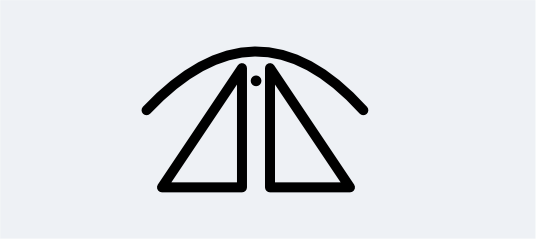
She held it up next to the horizon. Though it was a simple shape, the resemblance was obvious.
Mitra: It's... the view from here. The arc of heaven over the fangs of god, with the last star between them. Where did you see this?
Mitra: On a map in Mazatu's house. In what you call the Star-Lit age. Though I've not been here before, I believe it marked this area.
Mitra: But the fangs didn't exist back then. The mountain wouldn't have been split, I mean.
Menesa nodded.
Menesa: I'm unsure whether the glyph was his invention, but... the Oryth have a saying. The young see the world through their own eyes, and parents see through the eyes of their children, but sages see through the eyes of those who will live when the sage is long forgotten.
They were both silent for a moment.
Mitra: Not entirely forgotten. You have your memories. And we'll have your stories.